


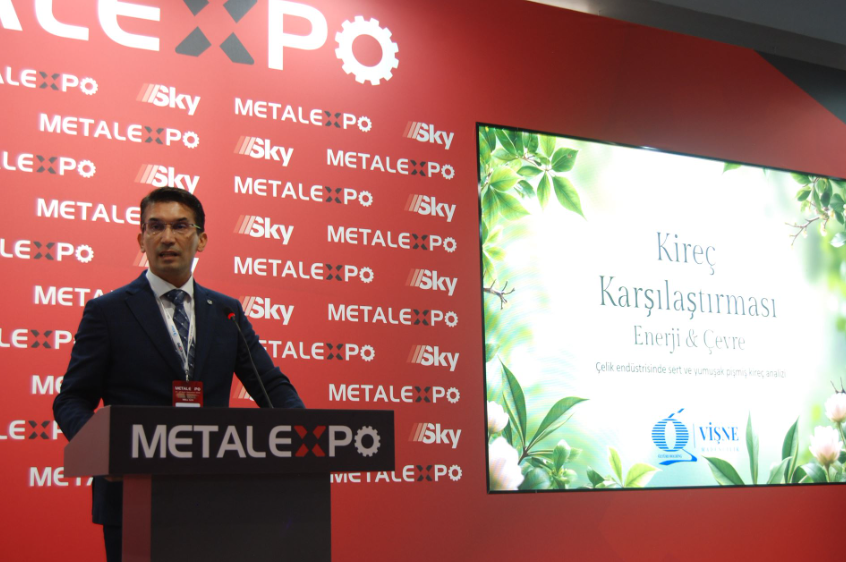
Our General Manager, Mr Nurol Şengel, spoke at the Green Generations Panel on 24 September 2025, the opening day of the 7th Metal Expo held at the Istanbul Expo Center. In his speech, he presented a comparative assessment of the different types of lime — a critical raw material for the steel industry — produced by different burning methods, in terms of energy consumption, cost and environmental impact.
Speaking at the Metal Expo Conference, Vişne Madencilik General Manager Nurol Şengel compared the different types of lime — a critical raw material for the steel industry — produced by different burning methods, in terms of energy consumption, cost and environmental impact.
Speaking at the Metal Expo 2025 conference, for which SteelRadar was a media partner, Şengel set out in detail the physical, chemical and metallurgical properties of hard-burnt and soft-burnt lime in his presentation titled “Lime Comparison: Energy & Environment”. He explained that hard-burnt lime, which is burnt at high temperatures, has a dense and strong structure, but that it slows down reaction rates in steelmaking and therefore leads to higher electricity consumption. By contrast, he noted that soft-burnt lime, with its porous, reactive and friable structure, dissolves much faster in the slag, and stated: “Soft-burnt lime improves desulphurisation while also delivering energy efficiency.”
The technical data presented revealed the tangible impact of this difference on production. Soft-burnt lime adds 24% CaO to the slag in just 8 minutes, whereas hard-burnt lime needs 17 minutes to achieve the same result. Şengel explained that this delay means longer processing times and higher electricity consumption in steel production, and emphasised that using soft-burnt lime delivers energy savings of approximately USD 2 million for every one million tonnes of steel produced.
Addressing the direct effect of quality differences on lime consumption, Şengel stated that low-quality lime with an active CaO content of 70% leads to 13,000 tonnes more lime consumption per year than high-quality lime containing 90% active CaO. He added that this excess consumption not only increases direct lime costs but also places additional energy and operating burdens on auxiliary processes such as logistics, grinding, handling and dust collection.
From an environmental perspective, the picture is striking. “According to the calculations, the excess consumption and energy losses caused by low-quality lime correspond to approximately 18,500 tonnes of CO₂ emissions per year,” said Şengel, emphasising that these emissions can be significantly avoided with soft-burnt lime, which dissolves faster and consumes less energy. “Energy efficiency is not only a cost advantage; it also means a smaller carbon footprint,” he said.
Şengel noted that advances in modern lime production technologies also support this transformation: “Thanks to new kiln technologies and carbon capture and storage (CCS) applications, the amount of CO₂ released into the atmosphere can be reduced. This is one of the most important tools for the green transition in the steel industry.”
Şengel concluded his speech with the words: “Soft-burnt lime delivers the same metallurgical performance with less lime, offering a solution that is both economical and environmentally friendly. This approach is becoming increasingly critical for reducing costs and improving sustainability in steel production.” He stressed that the industry's shift towards resource efficiency and low-carbon production is inevitable.