


In short How to use hydrated lime? Ca(OH)₂ is applied in three forms: dry powder, milk of lime (a suspension) and limewater (a solution). Correct use rests on choosing the form, a dosage corrected for purity, closed and dry storage, and protective equipment against dust. This guide sets out the common steps; each application page gives its details.
How to use hydrated lime, and in which forms is it applied?
Whatever the sector, hydrated lime (calcium hydroxide, Ca(OH)₂) is applied in three basic forms. Dry powder is dosed directly. Milk of lime is the suspension prepared by dispersing the powder in water. Limewater is the clear, saturated solution of hydrated lime and contains no solid particles. Because Ca(OH)₂ is only sparingly soluble in water, most applications in practice use dry powder or milk of lime. For the definition, production and quality parameters of the product, see our article on what hydrated lime is and how it is made.
The common steps are: choosing the form, calculating the dosage, preparing milk of lime (if needed), storage, unloading and workplace safety. For details specific to an application, see the relevant application pages: water and wastewater treatment, flue gas treatment and agriculture and soil improvement.

Dry powder or milk of lime?
The choice depends on the stream being treated, the equipment available and the reaction speed required. The table below gives a general comparison.
| Criterion | Dry powder | Milk of lime (suspension) |
|---|---|---|
| Preparation | None; dosed directly | The powder has to be dispersed in water |
| Equipment | Silo, screw or pneumatic feeder | Stirred tank, dosing pump |
| Reaction | Depends on particle fineness and contact time | Usually mixes more easily because it is already dispersed in water |
| Dust risk | High; closed feeding is needed | Low, although dust is generated during preparation |
| Typical use | Dry injection in flue gas; spreading directly on soil | pH adjustment in water and wastewater treatment |
In flue gas applications a very fine product (d90 < 10 µm) is preferred, because fine particles react faster with acid gases. The typical uses in the table are general practice and vary from project to project.
How is the dosage determined?
The logic of dosing rests on the amount of acid to be neutralised. A stoichiometric calculation gives the lower limit of the Ca(OH)₂ required:
| Substance to be neutralised | Reaction | Pure Ca(OH)₂ required (per 1 kg of substance) |
|---|---|---|
| Hydrochloric acid (HCl) | Ca(OH)₂ + 2 HCl → CaCl₂ + 2 H₂O | 1.016 kg |
| Sulphur dioxide (SO₂) | Ca(OH)₂ + SO₂ → CaSO₃ + H₂O | 1.157 kg |
These values are our own calculation and assume pure Ca(OH)₂. A real product is not pure, so the amount required grows with the Ca(OH)₂ content of the product. Hypothetical example: assume, for illustration only, that a product is 90% active (this is not the value of any Vişne Madencilik product). For 100 kg of HCl the pure Ca(OH)₂ requirement is 101.6 kg, while the requirement for this product is about 112.9 kg; for 100 kg of SO₂ the pure requirement is 115.7 kg, while the requirement for this product is about 128.5 kg. Actual consumption rises above this lower limit with purity and reaction efficiency; in flue gas in particular the ratio is above 1.
Overdosing, on the other hand, can push the pH above the target, so automatic pH control is recommended. If you are also considering preparing the product from quicklime instead of buying hydrated lime, see our article on choosing between quicklime and hydrated lime.
You can discuss dosage and product selection for your application with our technical team. Request product information and technical support for your application.
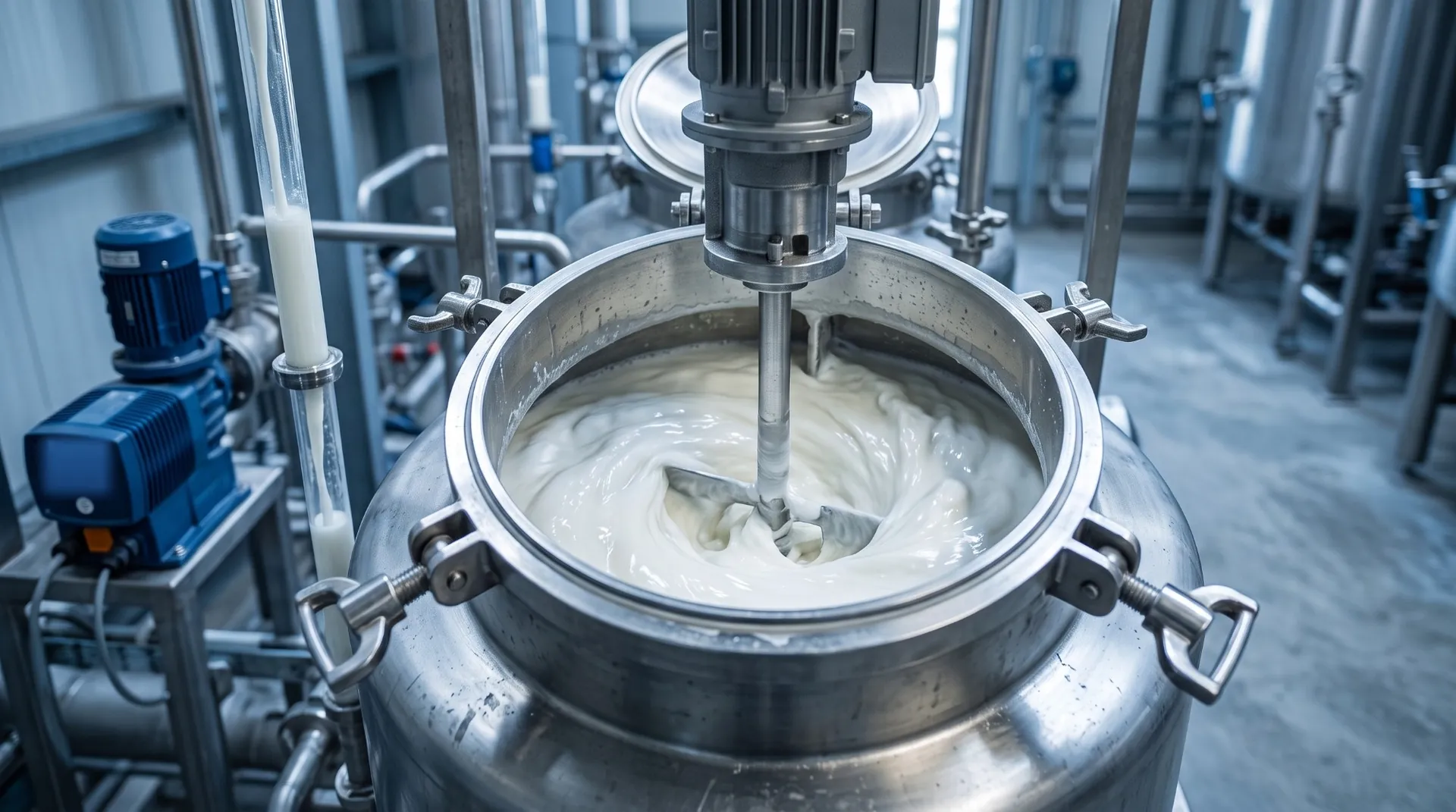
How is milk of lime prepared?
The general steps for preparing milk of lime are below; no figures are given because the suitable concentration depends on the application:
- Preparation: Read the safety data sheet (SDS) and put on protective equipment; confirm that the tank is clean.
- Water: Fill the mixing tank with the required amount of water.
- Addition: With the agitator running, add the hydrated lime gradually; do not tip the powder in all at once.
- Mixing: Mix until a homogeneous suspension forms and the particles no longer settle.
- Use: Feed the suspension to the dosing pump while continuing to mix so that it does not settle.
- Cleaning: Because the suspension can leave scale, flush the lines and the tank at regular intervals.
Concentration, mixing time and tank size are set according to the application; you can talk to our technical team.
How is hydrated lime stored?
Hydrated lime reacts with carbon dioxide in the air, becomes carbonated and loses its activity. The product should therefore be stored closed and dry. The mouth of an opened bag must be tied tightly and, if possible, the contents used soon. Protection from moisture also prevents caking. If a silo is used for large volumes, air intake and humidity must be kept under control. For the product's properties, see the hydrated lime product page.
What should you watch for in shipping and unloading?
Vişne Madencilik ships hydrated lime in three forms, and each calls for a different storage arrangement:
| Shipping form | Typical use | Storage and unloading note |
|---|---|---|
| 25 kg kraft bag | Small purchases | Closed, dry store; an opened bag must be closed again |
| 1-tonne big bag | Medium and large volumes | Area protected from rain and moisture; moved by forklift or crane |
| Bulk tanker (loose) | Large volumes; granular and powder | A silo is required; pressurised silo-to-silo transfer is used |
When unloading from a bulk tanker, dust control, a filtered air outlet and a closed line are important. For packaging selection and purchasing criteria, see our guide to packaging and quality criteria for bulk purchases.
Which precautions are needed for workplace safety?
Hydrated lime dust can irritate the skin, eyes and respiratory tract and may be corrosive. In dusty conditions a suitable dust mask, eye protection, gloves and protective clothing should be used, and the work area should be adequately ventilated. For exposure limits and first-aid steps, rely only on the product's SDS, official sources and local regulations. This article is not medical or legal advice. The European Lime Association's (EuLA) safe handling guide can also be consulted as a general reference.
What are the most common mistakes?
The table below is a general summary; the situation at your plant may differ.
| Mistake | Consequence | Precaution |
|---|---|---|
| Leaving a bag open | Carbonation; loss of activity | Close the bag and use it soon |
| Calculating the dosage without a purity correction | Incomplete neutralisation | Correct for the Ca(OH)₂ content of the product |
| Dosing without automatic pH control | pH rising above the target | Install automatic pH control |
| Leaving the suspension unstirred | Settling; dosing error | Keep mixing |
| Not using protective equipment in dusty conditions | Skin, eye and respiratory irritation | Use PPE; follow the SDS |
Frequently asked questions
Should hydrated lime be used as dry powder or as a suspension?
It depends on the application, the equipment and the reaction speed. Dry powder needs no preparation and is often used for dry injection in flue gas; milk of lime is dispersed in water and is common for pH adjustment in water and wastewater treatment. The target pH, daily consumption and existing dosing equipment should be weighed together, and our technical team can advise on the final choice.
What should be kept in mind when preparing milk of lime?
Fill the tank with water first, add the hydrated lime gradually while the agitator is running, and avoid raising dust. Mix until the suspension is homogeneous and keep mixing during use so that it does not settle. Scale can build up in the lines, so flush them regularly. Because concentration varies by application, rely on the product's SDS and the technical team's recommendation.
Should I set the dosage by pH?
The starting point of the dosage is the stoichiometric calculation; the actual setting comes from pH measurement. The calculation gives the lower limit of the amount required, and product purity and reaction efficiency raise it. Because overdosing can push the pH above the target, it is more reliable to adjust the dosage continuously with automatic pH control and to use the calculation only as a first estimate.
How should an opened bag be stored?
Hydrated lime reacts with carbon dioxide in the air and loses its activity, so tie the mouth of an opened bag tightly and keep it in a dry place. If possible, use the opened bag soon. Ask us about packaging options for the shipping form that suits your purchasing volume.
What does pressurised silo-to-silo transfer mean?
It means that product arriving loose in a bulk tanker is moved by pressurised transfer into the customer's silo. Vişne Madencilik's product information mentions silo-to-silo pressurised transfer for the bulk tanker option. This method needs a closed line, a filtered air outlet and a suitable silo design; telling us in advance what equipment you have at the delivery point helps plan the shipment.
What should I do if I am exposed to the dust?
Hydrated lime dust can irritate the skin, eyes and respiratory tract. In case of exposure, follow only the first-aid steps in the product's safety data sheet (SDS) and local emergency instructions, and see a doctor if necessary. This article does not give medical advice. As a precaution, suitable protective equipment should be used in dusty conditions.
Conclusion
- Hydrated lime is applied as dry powder or as milk of lime; the choice depends on the equipment and the application.
- Stoichiometric dosage is a lower limit: 1.016 kg of pure Ca(OH)₂ for 1 kg of HCl and 1.157 kg for 1 kg of SO₂; actual consumption rises with purity and efficiency.
- The product should be stored closed and dry, and automatic pH control should be used against overdosing.
- The dust is an irritant; protective equipment and the product's SDS should be the basis.
Request product information and technical support for your application. The average response time is under 24 hours.
Phone: +90 232 463 00 03 · Email: sales@visnemadencilik.com
Sources
- Calcium hydroxide — Wikipedia (molar mass, naming, uses).
- Calcium hydroxide (Q182849) — Wikidata (CAS 1305-62-0).
- EN 459-1:2015 — Building lime, Part 1: Definitions, specifications and conformity criteria — CEN, 2015 (iTeh Standards record).
- Safe handling of lime — European Lime Association (EuLA), 2015.
- Vişne Madencilik, hydrated lime product page (shipping, storage and use notes).
Author
Related articles
- What Is Hydrated Lime? Production, Quality and Uses — the production chain of calcium hydroxide and what its parameters mean.
- Quicklime vs Hydrated Lime: Differences and When to Choose Each — a comparison of the two products and the selection criteria.
- Bulk Hydrated Lime Buying Guide — quality criteria, standards, packaging and the factors that affect price.