


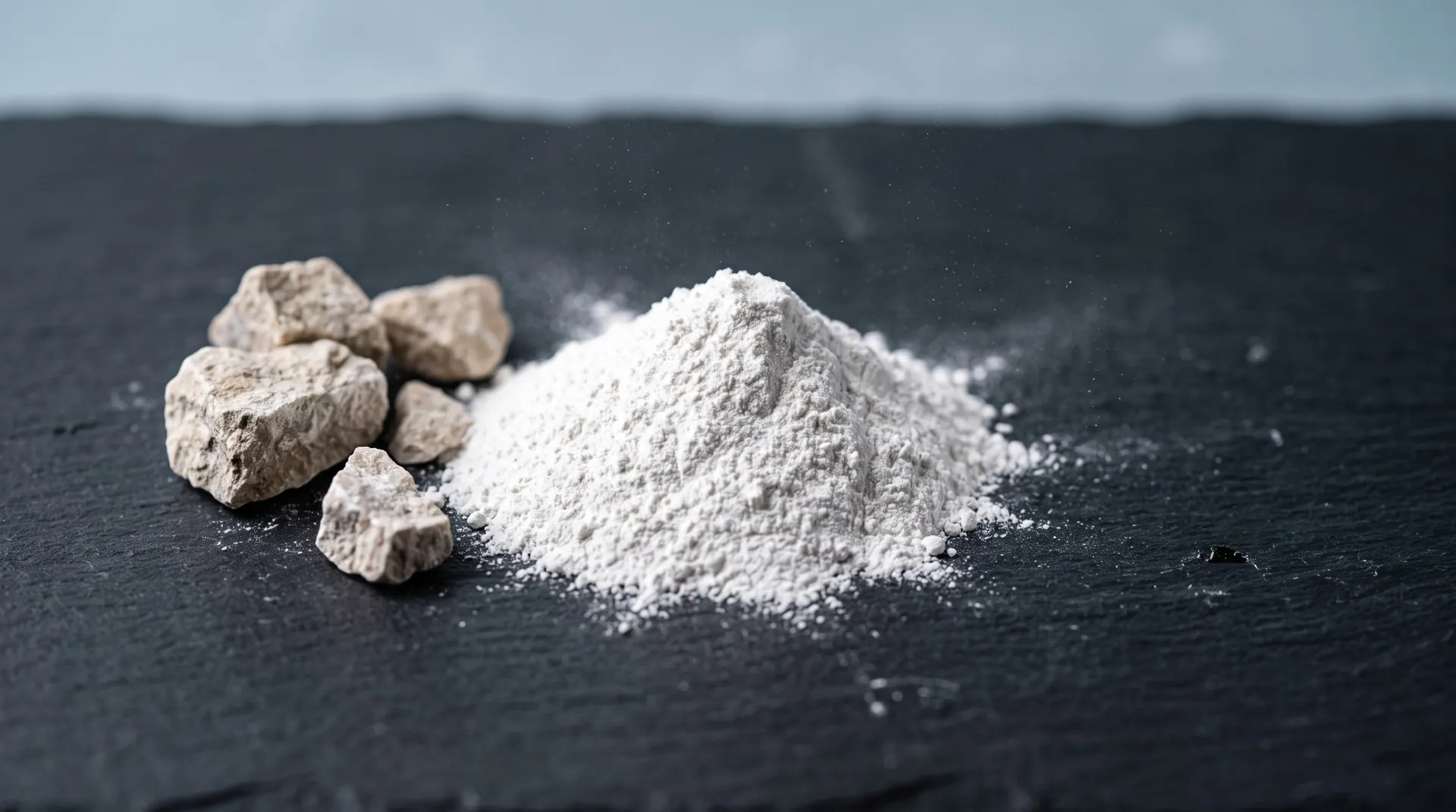
In short What is hydrated lime? Hydrated lime (slaked lime; calcium hydroxide, Ca(OH)₂) is a fine white powder made by reacting quicklime (CaO) with a controlled amount of water. It is used for pH adjustment and acid neutralisation in water treatment, flue gas treatment, construction, agriculture and soil improvement, and its quality is judged by purity, carbonation and fineness.
What is hydrated lime? Calcium hydroxide defined, with its synonyms
Hydrated lime (calcium hydroxide, Ca(OH)₂) is an inorganic compound formed when calcium oxide (CaO) reacts with water. It is a white, fine-grained powder with a molar mass of 74.09 g/mol. It is only sparingly soluble in water and behaves as a strong base in aqueous systems; the Vişne Madencilik product page gives its pH as 12.4–12.6.
The same compound goes by several names. “Slaked lime” and “hydrated lime” both describe calcium hydroxide, and in Turkish the term “hidrat kireç” is also used. Three look-alike terms, however, mean different things:
- Milk of lime: hydrated lime dispersed in water as a suspension.
- Limewater: the clear solution that is saturated with hydrated lime.
- Hydraulic lime: a separate binder that contains silicates and aluminates and can set even under water; it should not be confused with hydrated lime.
How is hydrated lime made?
The production chain starts with limestone and has four main steps:
- Raw material preparation: Limestone with a high calcium carbonate (CaCO₃) content is quarried, crushed and screened. At Vişne Madencilik's Çukurova / Gündoğan quarry (Ceyhan, Adana) the limestone is above 97% CaCO₃, and a crushing and screening plant operates on the same site.
- Calcination: The limestone is burnt in a kiln at 900–1100 °C. CaCO₃ decomposes into calcium oxide (CaO, quicklime) and carbon dioxide.
- Hydration (slaking): Quicklime is reacted with a controlled amount of water. The reaction CaO + H₂O → Ca(OH)₂ releases heat, which makes it exothermic.
- Fineness adjustment, packing and shipping: The product is brought to the required fineness and shipped in 25 kg kraft bags, 1-tonne big bags or bulk tankers.

How does the mass change along the production chain?
A mass balance shows how the raw material becomes the finished product. The values below are a theoretical calculation based on molar masses (CaCO₃ 100.09; CaO 56.08; H₂O 18.02; Ca(OH)₂ 74.09 g/mol) and assume pure substances.
| Step | Reaction | In | Out |
|---|---|---|---|
| Calcination | CaCO₃ → CaO + CO₂ | 100 kg CaCO₃ | 56.0 kg CaO + 44.0 kg CO₂ |
| Hydration | CaO + H₂O → Ca(OH)₂ | 56.0 kg CaO + 18.0 kg water | 74.0 kg Ca(OH)₂ |
| Overall | CaCO₃ → Ca(OH)₂ | 100 kg CaCO₃ | 74.0 kg Ca(OH)₂ |
Per unit of product: 1 kg of quicklime gives about 1.32 kg of hydrated lime and, in theory, needs 0.32 kg of water. In real production the yield depends on the purity of the raw material and on the burning and slaking conditions. The table also shows two practical consequences: impurities in the limestone directly lower the Ca(OH)₂ content of the product, and calcination is both an energy-demanding step and the one that releases 44.0 kg of CO₂ for every 100 kg of CaCO₃.
Which quality parameters matter, and what do they mean?
The quality of a batch of hydrated lime is not judged by a single value but by reading the parameters on the certificate of analysis together. The table summarises what each parameter shows and the values published on the Vişne Madencilik product page.
| Parameter | What it shows | Why it matters | Product page value |
|---|---|---|---|
| Ca(OH)₂ (available lime) content | The reactive share of the product | Directly affects dosing; the lower it is, the more product is needed for the same effect | — |
| CaO + MgO content | Total calcium and magnesium oxide equivalent | An indicator of overall purity | ≥ 90% (typically >93%) |
| CO₂ content | Degree of carbonation by CO₂ in the air | The carbonated part is no longer active | ≤ 7% |
| Fineness (below 90 µm) | Share of particles passing a 90 µm sieve | Finer product means more surface and faster reaction | ≥ 93% |
| pH value | Alkalinity in water | Shows neutralising strength | 12.4–12.6 |
| Bulk density | Mass per unit volume (as powder) | Determines silo and transport capacity | 0.30–0.60 g/cm³ |
| Colour | Visual indicator of purity | A superficial measure; not sufficient on its own | White |
The European building lime standard EN 459-1 divides air limes into the classes CL 90, CL 80 and CL 70 according to their CaO + MgO content, with separate limits for parameters such as CO₂ and available lime in each class. Only the certificate of analysis and the current text of the standard show which class a product falls into. We explain how to read these parameters when buying in our bulk hydrated lime buying guide; for all technical values see the specification table on the hydrated lime product page.
You can discuss which quality parameters are decisive for your application with our technical team. Contact our team for product information and technical support.
Where is hydrated lime used?
The common function of hydrated lime is to raise the pH of a medium and neutralise acidic components. The main fields of use are:
- Water and wastewater treatment: used for pH adjustment, neutralising acidic wastewater and precipitation. See the water and wastewater treatment application page.
- Flue gas treatment: captures acid gases such as SO₂ and HCl; very fine products (d90 < 10 µm) are preferred here. See flue gas treatment.
- Construction and building materials: used in mortar, plaster and building lime formulations. See construction and building materials.
- Agriculture and soil improvement: used to raise the pH of acidic soils. See agriculture and soil improvement.
- Soil improvement and stabilisation: used to improve the workability and bearing capacity of clayey soils. See ground improvement and stabilization.
It is also used in sectors such as food, paper, chemicals, iron and steel, and mining; in each case the form (dry powder or milk of lime), the dosage and the storage conditions are set separately.
When should you choose hydrated lime, and when quicklime?
Both are made from the same limestone; the difference lies in how they are used. Quicklime (CaO) reacts violently with water and releases heat, so it requires slaking equipment where it is used. Hydrated lime is a ready-to-use, more stable powder. The choice depends on the application, on the slaking and dosing equipment at the plant, and on storage conditions. For a comparison that sets out the decision criteria application by application, see the difference between quicklime and hydrated lime.
What should you watch for in safe handling and storage?
Hydrated lime dust can irritate the skin, eyes and respiratory tract and may be corrosive. In dusty conditions suitable protective equipment should therefore be worn, and the instructions in the product's safety data sheet (SDS) and local regulations must be followed. For exposure limits and first-aid steps, rely only on the SDS and official sources; this article is not medical or legal advice.
During storage the product should be kept closed and dry: hydrated lime reacts with carbon dioxide in the air and loses its activity. For the full set of dosing, storage and transport steps, see our guide to using, storing and handling hydrated lime safely. The European Lime Association's safe handling guide is also a useful general reference.
What do Vişne Madencilik's three integrated plants do in the hydrated lime chain?
Vişne Madencilik started in 1952 as a small limestone quarry in Bergama under the name Öztüre Kireç. Today it has a combined quicklime capacity of 2,250+ tonnes per day across three integrated plants and exports to 30+ countries. The table summarises their roles in the hydrated lime chain; the information is based on the company's own statements on its corporate pages.
| Plant | Location | Commissioned | Role in the chain |
|---|---|---|---|
| Çelemli | Yüreğir, Adana | 2010 | Main plant with 5 kilns; 1,250 tonnes/day quicklime capacity; its products include hydrated lime |
| Narlı | Pazarcık, Kahramanmaraş | 2021 | Plant with 4 kilns; 1,000 tonnes/day capacity; Lime Slaking Facility and Packaging Unit opened on 17 April 2025 |
| Çukurova / Gündoğan | Ceyhan, Adana | 2013 | Quarry and crushing-screening plant; limestone with 97%+ CaCO₃ |
The company states that the slaking and packaging investment at Narlı significantly increased its hydrated lime production capacity. For more on the plants, see our factories page.
Frequently asked questions
Are hydrated lime and slaked lime the same thing?
Yes. Hydrated lime, slaked lime and calcium hydroxide all refer to the same compound, Ca(OH)₂, and in Turkish “hidrat kireç” and “sönmüş kireç” are used interchangeably. What differs between products is purity, fineness and packaging. For that reason, when requesting a quotation or drawing up a contract it is safer to look at the parameters on the certificate of analysis than at the product name alone.
Are hydrated lime, milk of lime and limewater the same?
No. Hydrated lime is a dry powder. Milk of lime is the suspension prepared by dispersing that powder in water, and it is used for dosing in many treatment and process applications. Limewater is the clear solution saturated with hydrated lime and contains no solid particles. The active ingredient in all three is calcium hydroxide.
What is the difference between hydrated lime and hydraulic lime?
Hydrated lime is an air lime made only of calcium hydroxide; it hardens by carbonating with carbon dioxide in the air. Hydraulic lime contains silicates and aluminates and can set even under water. The two products differ in application, standards and dosing, so the specification and the quotation should state clearly which one is required.
Why does the Ca(OH)₂ content of hydrated lime matter?
The Ca(OH)₂ content shows the share of reactive material in the product. As it falls, more product is needed for the same neutralising effect and the dosing calculation changes. For bulk purchases you should therefore look not only at the product name but at the Ca(OH)₂, CaO + MgO, CO₂ and fineness values on the certificate of analysis together; our buying guide explains how to read them.
Does hydrated lime dissolve completely in water?
No. Hydrated lime is only sparingly soluble, so when added to water it forms a suspension, that is milk of lime, rather than a true solution. Its solubility decreases as the temperature rises. Because the undissolved part keeps reacting, mixing and fine particle size noticeably affect performance, and this should be taken into account in the dosing calculation.
Which product and quality suit my application?
That depends on the pH target of the application, the process form (dry powder or milk of lime) and the storage conditions. A reliable product choice needs the details of the application: the target pH, daily consumption, existing dosing equipment and storage space all decide it. You can ask our technical team; the technical values on the product page are a starting point for a first assessment.
Conclusion
- Hydrated lime, also known as calcium hydroxide, is a fine white powder obtained through the chain of limestone, quicklime and hydration.
- In theory 100 kg of limestone yields 74.0 kg of hydrated lime; the real yield depends on purity and process conditions.
- Quality is understood not from a single value but by reading Ca(OH)₂, CaO + MgO, CO₂ and fineness together.
- The product should be stored closed and dry, and because the dust is an irritant it must be handled in line with the SDS.
Request product information and technical support for your project. The average response time is under 24 hours.
Phone: +90 232 463 00 03 · Email: sales@visnemadencilik.com
Sources
- Calcium hydroxide — Wikipedia (molar mass, naming, uses).
- Calcium hydroxide (Q182849) — Wikidata (CAS 1305-62-0).
- EN 459-1:2015 — Building lime, Part 1: Definitions, specifications and conformity criteria — CEN, 2015 (iTeh Standards record).
- Safe handling of lime — European Lime Association (EuLA), 2015.
- Vişne Madencilik, hydrated lime product page and factories page (product and plant values).
Author
Related articles
- Quicklime vs Hydrated Lime: Differences and When to Choose Each — a comparison of the two products and the selection criteria.
- How to Use Hydrated Lime: Dosing, Storage and Safe Handling — dosing, preparing milk of lime, storage and workplace safety.
- Bulk Hydrated Lime Buying Guide — quality criteria, standards, packaging and the factors that affect price.